
Fraud Attack Radar
AI-powered fraud detection software for coordinated attacks and fraud rings
Alloy's Fraud Attack Radar proactively detects coordinated fraud at the portfolio level, so you can stop an attack without shutting down the onboarding funnel.
“Fraud Attack Radar enables us to act quickly before any loss is incurred.”
Angie Crosby VP of PMO, Launch Credit Union
-
0
Zero loss from a coordinated fraud ring
-
95%
Fraud attempts caught and immediately auto-declined
-
5%
Remaining fraud attempts caught through step-up verification
OUR APPROACH
Portfolio-level detection buys you room to respond
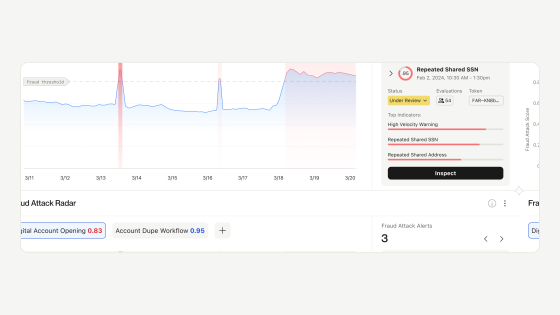
Detect fraud sooner
Get alerted before an attack escalates
Alloy’s AI-powered predictive model for coordinated onboarding attacks monitors for portfolio-level patterns associated with fraud rings, bot attacks, and other high-velocity fraud activity. Then, it proactively alerts your team when an attack is mounting, with no manual dashboard monitoring required.
Minimize channel disruption
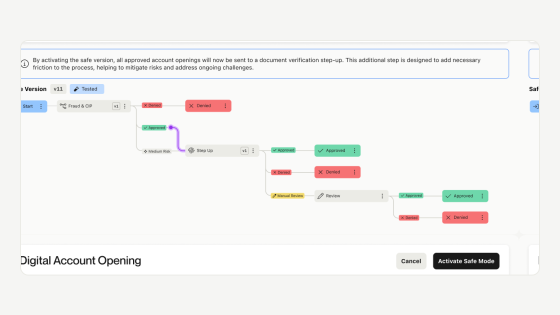
Keep approving good applicants mid-attack
Shutting down a channel can stop an attack, but it also stops legitimate applications. Fraud Attack Radar lets your team activate pre-approved fallback safe-mode policies and step-up verification instead, containing the threat while keeping the onboarding funnel open for lower-risk applicants.
Streamline operations
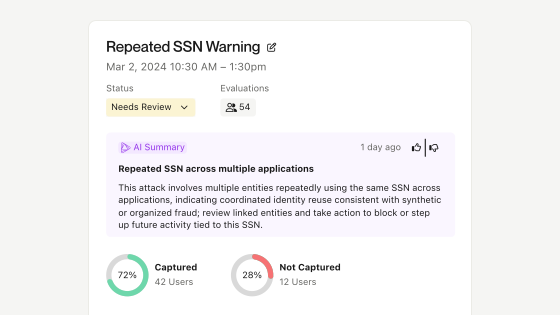
Refocus analyst effort on real risk
An influx of applicants from a marketing campaign can look like an attack to a generic anomaly-detection system. Fraud Attack Radar identifies the characteristics of coordinated fraud, so your team spends less time on false positives and manual review and more time responding to legitimate threats.
Get alerted before an attack escalates
Alloy’s AI-powered predictive model for coordinated onboarding attacks monitors for portfolio-level patterns associated with fraud rings, bot attacks, and other high-velocity fraud activity. Then, it proactively alerts your team when an attack is mounting, with no manual dashboard monitoring required.
Keep approving good applicants mid-attack
Shutting down a channel can stop an attack, but it also stops legitimate applications. Fraud Attack Radar lets your team activate pre-approved fallback safe-mode policies and step-up verification instead, containing the threat while keeping the onboarding funnel open for lower-risk applicants.
Refocus analyst effort on real risk
An influx of applicants from a marketing campaign can look like an attack to a generic anomaly-detection system. Fraud Attack Radar identifies the characteristics of coordinated fraud, so your team spends less time on false positives and manual review and more time responding to legitimate threats.
FRAUD INTELLIGENCE
Turn AI-powered alerts into immediate action
Fraud Attack Radar runs inside Alloy's identity and fraud prevention platform, alongside the onboarding workflows and policies you already manage. When the model flags an attack, your team acts on the alert in the same platform, from the first containment step through long-term policy changes.
-
Real-time attack detection
Receive alerts by email and in the Alloy dashboard when patterns of suspicious activity across applications point to a coordinated attack.
-
Rapid containment
Adjust controls in real time so risky applications face added friction while legitimate applicants keep moving through the funnel.
-
Remediation
Triage faster by picking out impacted entities and using leading indicators to prioritize investigation, cleanup, and long-term policy changes.
-
Actionable insights
See funnel health, leading indicators, and explainable insights at a glance for reporting to fraud operations leaders.
RESOURCES
Go deeper


FAQs
-
What is Fraud Attack Radar?
Fraud Attack Radar is an AI-powered, predictive machine learning model that helps financial institutions and fintechs detect coordinated fraud attacks in the onboarding funnel. The model monitors risk at the portfolio level, alerts your team when an attack is mounting, and lets you contain the threat inside the Alloy platform without shutting down your funnel. As part of Alloy's Actionable AI suite, Fraud Attack Radar covers onboarding, while Fraud Signal scores individual customer risk after onboarding, including account takeover.
-
How does Fraud Attack Radar detect coordinated fraud attacks?
Fraud Attack Radar applies artificial intelligence to your full population of applications, combining anomaly detection with time series methods, connecting signals across thousands of submissions to find shared infrastructure, timing anomalies, and behavioral similarities associated with organized fraud. Fraud Attack Radar also flags novel attack types alongside known schemes, picking up the patterns that new tactics leave across an applicant population when deployed at scale.
-
What kinds of fraud is Fraud Attack Radar able to catch?
Fraud Attack Radar catches fraud rings, bot attacks, and other large-scale attacks on the onboarding funnel, including synthetic identity fraud that uses blended or stolen personally identifiable information (PII). Strong indicators of a coordinated attack include the same IP address or other PII repeating across distinct applicants, auto-generated emails, high-volume email domains, and a spike in denials. Fraud Attack Radar flags early-stage probing as well, catching fraudsters who test your controls before scaling up to a full attack.
-
Does Fraud Attack Radar slow down legitimate customers?
Fraud Attack Radar is designed to keep legitimate applicants moving through onboarding, even during an attack. When the AI model flags a coordinated attack, your team can activate pre-approved safe-mode policies that add step-up verification or multi-factor authentication (MFA), document verification, or biometric authentication for risky applicants while lower-risk applicants continue through the funnel. The onboarding channel stays open for growth while your team contains the threat.
-
How is a portfolio-level fraud risk score calculated?
Fraud Attack Radar calculates a portfolio-level fraud risk score for each customer onboarding workflow where you enable the model, drawing on activity across the workflow's full population of applications. Inputs include evaluation and denial volume, PII velocity (how quickly the same personal details reappear across applications), and industry onboarding data. The AI model updates the score at regular intervals and shows which features contributed most. When the score crosses the alert threshold, your team receives an alert to triage, investigate, and deploy new policies.