







ORCHESTRATION & DECISIONING
Smarter identity and fraud risk decisions, informed by rich data context
Alloy runs every fraud, compliance, and risk check through a unified decisioning engine with open orchestration at its core.
-
300+
Third-party data solutions
-
<300
Millisecond decisioning speed
-
195
Global markets covered
DATA ORCHESTRATION
Multiple data sources, one automated decision
Data orchestration is the process of connecting, sequencing, and combining signals from multiple data sources to power a single, automated decision. In financial services, it’s what makes it possible to run identity, fraud, and credit checks simultaneously without building and maintaining each integration yourself.

The industry’s broadest network of identity and fraud risk data
-
Open marketplace
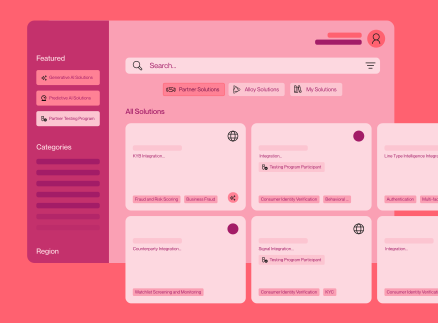
Every decision starts with data. Through Alloy’s in-dashboard Partner Center, you can browse and access 300+ identity and fraud solutions. KYC, KYB, document verification, device intelligence, behavioral analytics, credit data, watchlists, and more are all available through a single integration. Evaluate and deploy the best-performing providers without vendor lock-in or costly rebuilds.
-
Smarter testing and optimization
Alloy’s open orchestration platform and proprietary testing suite gives you the flexibility to easily evaluate, swap, and optimize your vendor mix. Test competing providers, build in redundancy, and adapt faster as fraud patterns and business needs evolve.
-
Production-ready global solutions
Access over 300 top data sources through Alloy’s fully productized marketplace, backed by contracted partner agreements and integrations Alloy delivers and maintains on behalf of clients. As your business expands into new product lines or markets, activate global solutions without custom build or added technical lift.
-
Operational efficiency and reduced costs
Alloy runs a dedicated program to manage partner migrations and upgrades so you don’t have to. With centralized tracking and end-to-end support, we handle the technical, legal, and operational work to reduce costs, accelerate time to launch, and keep you on the latest capabilities.
-
Adaptable configuration
The Alloy SDK extends the full data network into your customer-facing flows, giving your team a single, configurable layer for document verification, device signals, behavioral risk, and step-up verification. Every integration is built and maintained by Alloy, so your engineers can focus on launching new products.
OPEN PLATFORM
Vendor-neutral by design
Not all orchestration platforms are equal. Some are built by data providers to bundle and sell their own products, which means the platform’s incentives aren’t aligned with yours.
Alloy takes a different approach: an open, vendor-neutral infrastructure layer that connects to any data source or provider, without bias. You choose the best tools for your business. Alloy unifies them to work as one.
Workflow Editor & Policy Library
Translate your risk policies into automated decisions
End-to-end policy automation
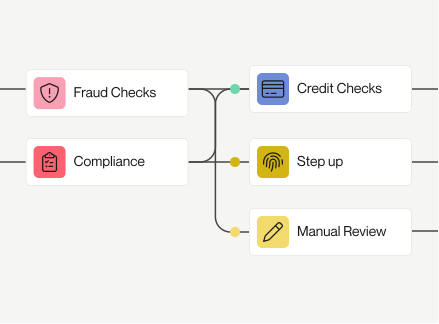
Your team can build and modify decisioning logic visually, from simple backstop rules to complex multi-step policies, without engineering resources. Update it in minutes when conditions change. Alloy Journeys then orchestrates that logic automatically across the customer lifecycle, giving your team a complete view of every sequential risk decision with a fully auditable record for every outcome.
Tap into Alloy’s risk expertise
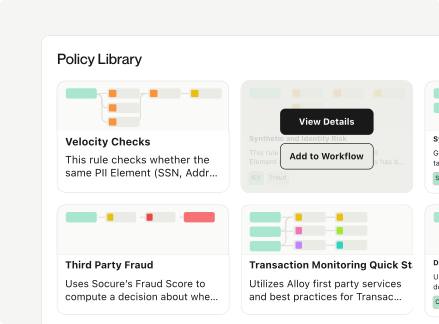
Leverage decisioning strategies built from Alloy’s expertise supporting millions of end-users at leading fintechs, banks, and credit unions. Deploy proven, reusable logic built from real-world use cases that are continuously refined as trends evolve, so you can move faster, stay aligned on best practices, and adapt confidently as risk evolves.
TESTING SUITE
Experiment and iterate as you expand
The Alloy Testing Suite lets risk and compliance teams test every policy change before it goes live, so your team can move faster, expand into new markets, and launch new products with confidence.
-
Backtesting
Run historical data through your updated workflow in a production environment to simulate outcomes before committing to a change. Make inline edits to your workflow, and instantly see the projected impact on approval, denial, and review rates, including the effect of adding or swapping a data vendor. See exactly how a new policy would have performed against real past decisions, so you go live with hard evidence.
-
Champion challenger
A/B test up to five versions of your decisioning logic simultaneously. Configure sample size, timeframe, and customer population allocation, then let built-in analytics surface which version performs best.
-
Shadow testing
Run a new policy in parallel against live production data. Shadow testing uses cached data or real production calls to give you an accurate picture of how a new workflow would behave under actual conditions before it goes live.
-
Sandbox and unit testing
Test evaluation logic and payload responses autonomously in the dashboard, without needing to run production traffic.
AUDIT TRAIL & REPORTING
Transparent decisions with built-in performance insights
-
Clear audit trail
Automatically log every action on a customer record, like what data was reviewed, which policy triggered the outcome, and who approved the final decision.
-
Performance analytics and reporting
Visualize approval, denial, and manual review rates, data usage, and workflow performance directly in the Alloy dashboard.
-
Versioning and permissioning
Track every workflow change, clone policies for testing, and roll back to previous versions if needed.
GET STARTED
The platform 900+ financial organizations trust for identity risk
Alloy’s orchestration and decisioning engine connects your data, automates your workflows, validates your policies, and keeps your team audit-ready across onboarding, fraud, compliance, credit, and beyond.
Resources
Go deeper

FAQs
-
What is data orchestration, and why does it matter for financial services?
Data orchestration is the process of connecting, sequencing, and combining signals from multiple data providers to inform a single automated decision. For financial institutions and fintechs, data orchestration makes it practical to run KYC, fraud, and credit checks simultaneously across dozens of providers without building and maintaining each integration separately. Alloy’s open orchestration model connects to the industry’s broadest network of data solutions through a single API, so teams can add, test, and swap providers as their needs evolve.
-
How does Alloy's decisioning engine reduce false positives without letting fraud through?
Alloy reduces false positives by evaluating risk signals in context rather than in isolation. Rule-based systems flag activity that crosses a threshold without knowing who the customer is or how they normally behave. Alloy's rules engine is the layer on which teams configure the policies the decisioning engine applies. It combines configurable rules with machine learning models that score each customer as an entity, weighing user behavior, account history, device signals, and third-party data together. High-risk interactions get escalated; low-risk ones move through without friction. The result is a more precise risk assessment that catches more fraudulent activity without penalizing legitimate customers, which directly reduces fraud losses from both missed fraud and unnecessary friction. Fraud teams can tune thresholds based on their specific risk appetite and operational capacity, and the AI-driven models adjust continuously as patterns shift.
-
How does Alloy help fraud teams stay ahead of emerging fraud trends in real time?
Fraudsters adapt quickly, and static controls can't keep pace. Alloy's fraud management platform addresses this in two ways. First, the no-code rules engine lets fraud teams update decisioning logic in minutes rather than requiring engineering sprints — so when a new attack pattern emerges, your controls can respond the same day. Second, Alloy's AI-powered Fraud Signal model is trained continuously on anonymized data across 900+ institutions, which means it detects new fraud patterns from across the network before your institution has encountered them. Scams, authorized push payment fraud, and other fast-moving threats are surfaced through behavioral anomalies and real-time risk scoring rather than waiting for a known signature to match. The combination of human-configurable rules and continuously improving machine learning models is what makes fraud mitigation at scale sustainable.
-
How does Alloy protect against account takeover and synthetic identity fraud?
Account takeover and synthetic identities are two of the hardest fraud types to catch because they exploit legitimate-looking signals. Alloy addresses both through layered identity verification and risk assessment. For account takeover, the decisioning engine evaluates login events, device fingerprints, geolocation changes, user behavior anomalies, and authentication signals together. Step-up verification with biometrics triggers when the combination suggests the genuine account holder isn't behind the interaction. For synthetic identities, Alloy runs data sources in tandem rather than sequentially, including third-party models that specialize in detecting fabricated or blended identities. Signals that individually look clean can reveal fraudulent activity when evaluated together. Payment fraud and chargeback losses tied to both fraud types are reduced because the decisioning engine catches bad actors at the point of application and continues monitoring throughout the customer lifecycle.
-
How does Alloy balance fraud prevention with a good customer experience?
The customer experience and fraud prevention are often framed as a tradeoff. Alloy's position is that the tradeoff only exists when controls lack context. When a rules engine applies the same friction to every interaction regardless of risk signals, low-risk customers bear the cost of worst-case controls. Alloy's decisioning engine evaluates each interaction individually, weighing device, behavioral, identity, and transaction signals to determine the appropriate response for that specific customer at that specific moment in their customer journey. Low-risk customers move through without interruption. High-risk interactions trigger step-up verification calibrated to the level of risk involved. This approach to risk management lets financial institutions optimize approval rates, reduce unnecessary friction, and streamline the user experience without relaxing the controls that matter. Across the customer lifecycle, the engine continuously updates each customer's risk profile, so decision-making stays current even as behavior evolves.