Why risk-based authentication is the next frontier for financial institutions - and why we built it into Alloy
Jun 24, 2026
Every quarter, I talk to fraud and product leaders at large banks and credit unions who are dealing with a version of the same problem: stop increasingly sophisticated fraud while making the customer experience good enough to win top-of-wallet.
Authentication is where that tension comes to a head. According to Alloy's 2025 State of Scams Report, 97% of consumers say fraud prevention is a top factor when choosing a financial institution, but from the customer's side of the screen, authentication is fraud prevention.
Every login, every password reset, every step-up challenge carries real stakes: too little scrutiny and fraud gets through, too much and a good customer may leave in frustration. Most teams default to one-size-fits-all experiences because they are operating with static controls, fragmented systems, and a fraction of the context they need.
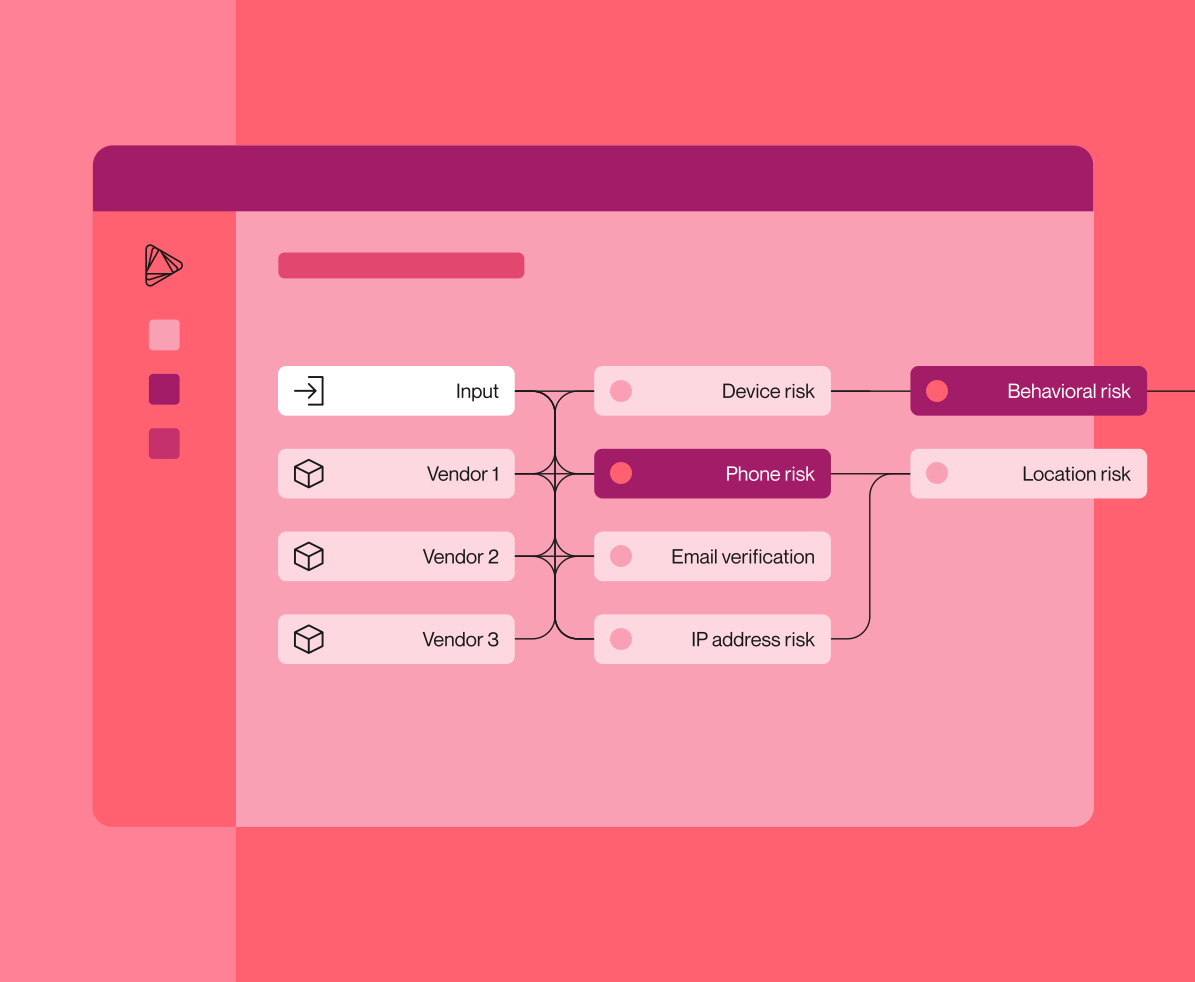
This is a pressing concern we’re already solving for Alloy clients today, and one that will only grow more complex as AI agents begin to act on behalf of customers. Today, we’re diving deeper into Alloy’s risk-based authentication solution: continuous, contextual, and adaptive assessment of every interaction across the full customer lifecycle.
The problem with how authentication works today
Most digital authentication strategies are built around a single moment: login. Did the credentials check out? Did MFA pass? These questions matter, but sophisticated fraudsters can make it through. Sophisticated attacks play out across a sequence of events that individually may appear normal, but collectively spell account takeover. And the blunt application of step-up challenges to every high-risk action treats every legitimate customer like a potential fraudster.
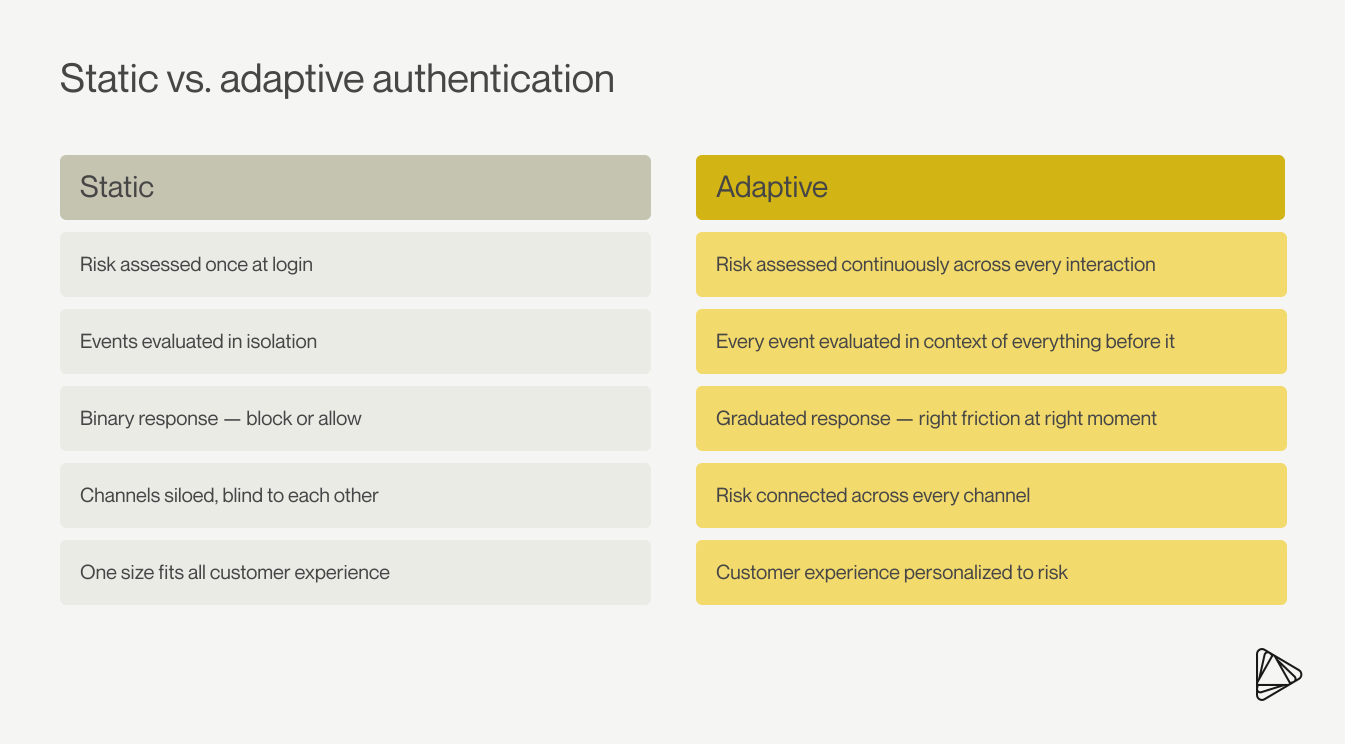
One of the most common failings: the richest identity and fraud signals a bank collects (at onboarding, built up through servicing, ongoing interactions, and transaction history) never make it into authentication decisions. Each event is evaluated without this critical context, resulting in point-in-time decisions, higher call center volume, increased fraud exposure, and lost customer trust.
And it’s about to get harder: Know Your Agent (KYA)
That signal gap is about to widen. AI agents are already being deployed on behalf of customers to check balances, initiate transactions, and execute workflows — and unlike a traditional fraudster, they may clear every authentication gate. To a static system, they appear to be a successfully authenticated human. But successfully authenticated doesn’t mean unconditionally trusted.
The core challenge is verifying not just whether it’s an agent or human but what it is permitted to do within a given session. Banks may be comfortable with agents reading account balances but not initiating a wire transfer. Static infrastructure can’t make that call, but this is exactly the construct that our risk-based authentication solution is built to handle: continuous risk evaluation, dynamic entitlements, and session-aware decisioning that governs not just who gets in, but what any authenticated session can do. Stay tuned for a deeper look at how risk-based authentication becomes the foundation for safe, permissioned agentic banking.
How Alloy’s risk-based authentication solution works
Alloy’s risk-based authentication solution is built around the following core components that together close that gap by evaluating every event in every session across every channel.
1. Pre-authentication orchestration
Pre-authentication is one of the riskiest moments in a customer journey. When a customer hits “forgot username” or initiates a password reset from an unrecognized device, the bank has limited context to verify their identity, leaving customers at the mercy of blunt one-size-fits-all controls.
Alloy operates in that gap, enriching that recovery flow with device intelligence, geolocation, and behavioral signals in real time, enabling the financial institution to make a data-rich risk decision before credentials are ever entered. High-confidence legitimate customers get a frictionless or a digital self-remediation path forward, while suspicious attempts get targeted step-ups before they ever reach a call center queue.
2. Persistent trust profile
Most institutions put significant effort into verifying identity at account opening, capturing a wealth of high-fidelity signals ranging from device fingerprint, IP reputation, behavioral biometrics, and KYC verification data. Alloy stores and passes this information downstream, enabling financial institutions to benefit from a continuously updated trust profile for each customer. Every subsequent interaction (e.g., login, password reset, transaction, contact detail change) is then evaluated against the “normal” baseline for that specific customer, so financial institutions can be alerted in real time when something deviates.
3. Continuous omnichannel monitoring
A customer’s relationship with their financial institution doesn’t happen in a single channel, and neither does fraud. Credential update through the call center, followed by contact detail changes in digital banking, and finally an in-branch transfer request: each event might look routine in isolation, but together form a pattern that static, siloed authentication controls are structurally unable to see. Today, most financial institutions run separate authentication stacks for digital, call center, and branch channels – and that fragmentation is exactly what sophisticated fraudsters exploit.
Alloy applies unified, dynamic decisioning at every touchpoint across every channel, closing the gaps that fraud exploits while enabling trusted customers to move faster. Call center agents see the same trust signals that the digital session has already established, reducing unnecessary verification overhead. The experience and protection reflect who the customer actually is, not which channel they happened to use to reach the organization.
4. Graduated dynamic responses
Not every elevated risk signal warrants the same response. Alloy’s SDK orchestrates friction proportional to the risk presented, whether through passive device checks, OTP’s, or document verification. For the highest-risk outcomes, we enable banks to dynamically restrict entitlements or terminate the session entirely. Every decision is versioned and auditable, so teams can point to exactly why a customer was stepped up, restricted, or blocked.
5. Session-aware decisioning
A login from a new device looks unremarkable in isolation, but when that same session immediately proceeds to silence notifications, update contact details, and initiate a transfer to an unknown counterparty, the sequence is unmistakably risky. Alloy evaluates every in-session event in context, degrades trust as risk accumulates, and adapts authentication requirements in real time. Sessions can be terminated the moment the picture turns fraudulent, and well before money moves from the account.
6. Predictive entity risk scoring
Conversely, entity risk can catch what a session risk may not flag by shedding the broader context of prior fraud flags or accumulated context across sessions. Think of entity risk as long-term memory, complementing the short-term memory session risk provides.
We do this through Fraud Signal, Alloy’s ML-powered predictive model, which works continuously in the background to aggregate signals across the full customer lifecycle and updates in real time with every event. Fraud Signal can provide insights into gradually escalating suspicious behavior that no single session reveals. For example, a customer, whose entity risk is elevated after a recent call center contact detail change, logs in from an unrecognized device to their online banking, triggering a session risk flag. While each signal alone might be explainable, together the elevated session and entity risk give high confidence that the pattern is indicative of account takeover and warrants a step-up challenge.
Why Alloy is uniquely able to solve this
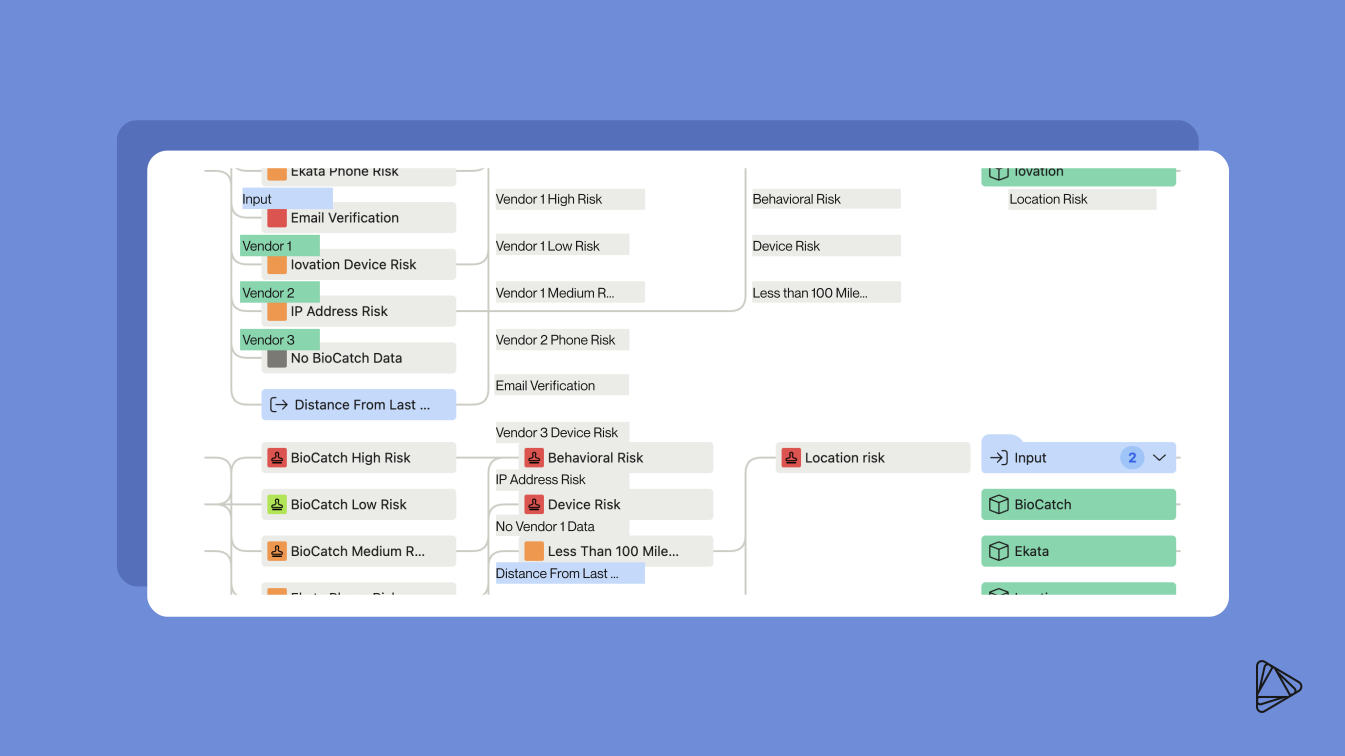
The capabilities described above could, in theory, be assembled from multiple point solutions. The reason they work better together inside Alloy comes down to three structural advantages that no combination of standalone tools can replicate.
Multi-signal orchestration: No single signal is sufficient. Alloy operates as a vendor-neutral open orchestration layer, drawing on 270+ pre-integrated data providers across device intelligence, behavioral biometrics, geolocation, and network signals. We orchestrate across best-in-class providers for each signal type, waterfall checks based on the risk presented, and let teams test and refine without engineering cycles or vendor lock-in.
Onboarding data that doesn’t expire: The signals captured at account opening are the richest identity data a bank will ever collect on a customer. Instead of treating identity verification as a one-time snapshot, Alloy carries those signals forward as an evolving risk profile, so recognized customers move through, call center volume drops, and the gaps left by channel-siloed systems get closed.
Policy control without engineering dependency. Risk teams can write, test in simulation, and deploy rule changes without a development sprint. Every decision is versioned and auditable, so when a regulator asks why a customer was stepped up or blocked, the answer is immediately available.
What this delivers: Risk-based authentication as a growth lever
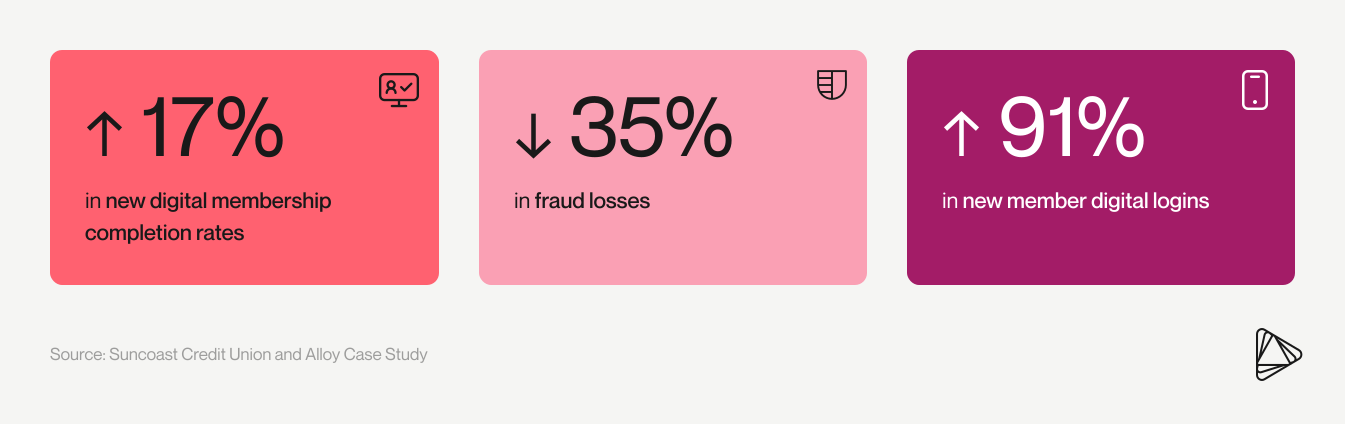
Digital adoption at Suncoast Credit Union, a top-ten U.S. credit union with over $20 billion in assets, was growing fast when fraudsters started targeting accounts via compromised credentials and new device logins. False-positive alerts were flooding manual review queues, forcing a familiar tradeoff: tighten controls and stall adoption, or ease up and accept more fraud exposure.
Alloy’s risk-based authentication solution gave them a third path: by enriching every login with device intelligence and behavioral context, legitimate members moved through seamlessly while suspicious actors were flagged earlier. The result: 98% of logins are now auto-decisioned, fraud losses reduced by 35%, and new member digital logins jumped 91% within the first day of account opening, which is proof that getting authentication right is a growth strategy, not just a fraud control.
“Alloy gave us stronger authentication and the ability to make decisions in real-time, which helps reduce fraud loss. We saw a significant decrease in fraud loss per member. Enriching member logins with device intelligence helped us identify suspicious actors earlier and reduce account takeover activity before it progressed.”
Nicole Allen
Vice President of Fraud Management, Suncoast Credit Union
Read the full Suncoast case study
Suncoast can now give its legitimate customers a faster, smoother digital experience because it has better tools for identifying who its legitimate members are. The takeaway: lower fraud losses and better customer experience shouldn’t be in tension.
This is the broader point we’ve been making for years. Financial institutions that get authentication right don’t just lose less to fraud; they win more customers. Retention improves because good customers aren’t treated like suspects. Digital adoption grows because the experience earns it. Conversion rates on new products improve because the friction profile reflects actual risk, not worst-case-scenario rules applied to everyone.
See it in action
If your institution is dealing with authentication-related fraud losses, conversion drop-off, or call center volume that shouldn’t exist, this is exactly what risk-based authentication is designed to address. We’d love to walk through what this looks like for your specific situation.

Parilee Edison Wang is the Chief Operating Officer and Chief Product Officer at Alloy. She has spent the last 15 years working in product and fintech, driven by the opportunity to help solve interesting problems without obvious answers. Prior to Alloy, Parilee led Product at Bread and was a part of the product team at OnDeck. Parilee received her bachelor's degree in international relations from Stanford University in 2008 and a master’s in business administration from Harvard Business School in 2013.