
Article
Alloy’s Fraud Signal scores identity risk across the lifecycle, so financial organizations can see the full picture of risk for customers, catching what rules alone miss and grow with confidence by letting more good customers move forward.
"Fraud Signal delivers the precision and speed necessary to intercept emerging fraud, effectively augmenting the capabilities of our existing controls and leading to a tangible enhancement of our overall risk coverage."
—Stash
A client using Fraud Signal may see results up to:
fraud capture
reduction in false positives
days earlier detection on average
Fraud Signal keeps scoring identity risk after onboarding, giving your team the confidence to approve more good customers upfront, including applicants that overly conservative rules turn away. Authenticate legitimate customers, and add dynamic friction for higher-risk users.
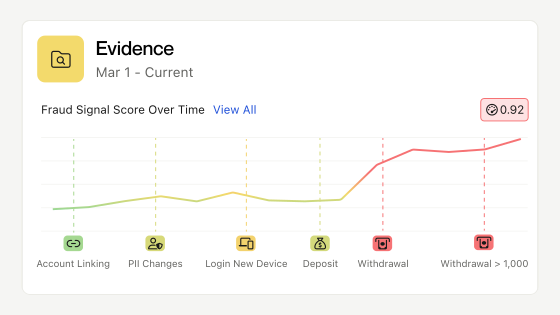
Fraud Signal's identity-centric model connects onboarding signals to post-onboarding behavior to identify fraud earlier than rules or isolated event scoring can. With a continuous score for each customer, your team can detect and prevent fraud before a transaction takes place.
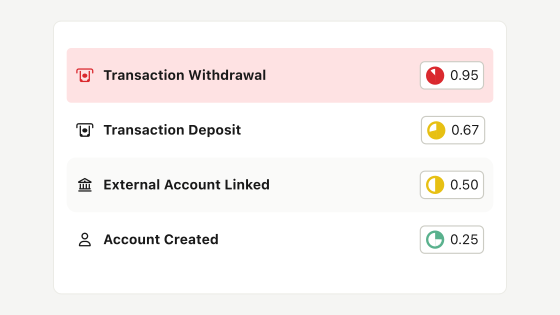
Fraud Signal suppresses false positives and prioritizes the riskiest customers first, helping your team scale fraud investigations without scaling manual effort. Analysts spend less time on low-value manual reviews and rule maintenance, freeing them for higher-value investigations.
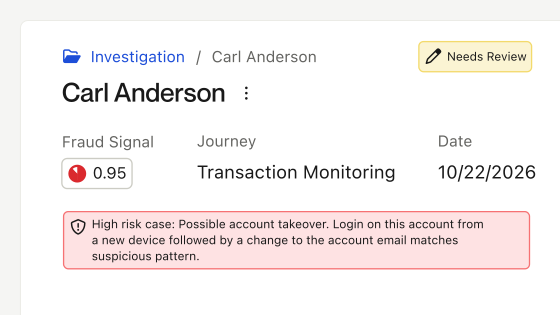
Fraud Signal keeps scoring identity risk after onboarding, giving your team the confidence to approve more good customers upfront, including applicants that overly conservative rules turn away. Authenticate legitimate customers, and add dynamic friction for higher-risk users.
Fraud Signal's identity-centric model connects onboarding signals to post-onboarding behavior to identify fraud earlier than rules or isolated event scoring can. With a continuous score for each customer, your team can detect and prevent fraud before a transaction takes place.
Fraud Signal suppresses false positives and prioritizes the riskiest customers first, helping your team scale fraud investigations without scaling manual effort. Analysts spend less time on low-value manual reviews and rule maintenance, freeing them for higher-value investigations.
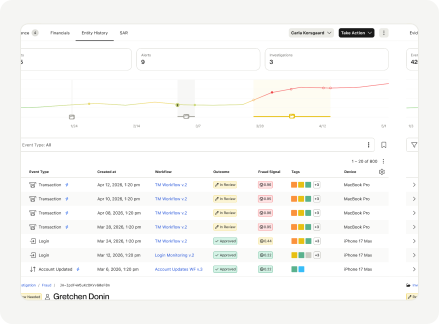
Fraud Signal ingests onboarding data, account activity, transactions, and non-monetary events like logins, device changes, and account information updates, building one evolving risk profile for each customer. Evaluating the identity behind each event surfaces fraudulent activity that looks benign in isolation.

Fraud Signal is trained on aggregated fraud patterns across Alloy's network of 900+ financial institutions and fintechs. This allows Alloy clients to leverage shared expertise to detect emerging fraud earlier and with greater confidence.
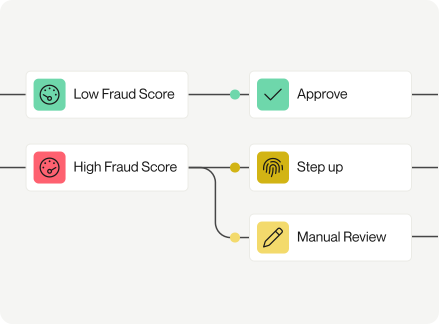
Fraud Signal delivers a single score from 0 to 0.99 for each customer in real time, along with accompanying qualitative indicators. Built natively into Alloy's decisioning engine, the score drives action directly in your workflows, triggering step-up verification, escalation, or approval.
Fraud Signal ingests onboarding data, account activity, transactions, and non-monetary events like logins, device changes, and account information updates, building one evolving risk profile for each customer. Evaluating the identity behind each event surfaces fraudulent activity that looks benign in isolation.
Fraud Signal is trained on aggregated fraud patterns across Alloy's network of 900+ financial institutions and fintechs. This allows Alloy clients to leverage shared expertise to detect emerging fraud earlier and with greater confidence.
Fraud Signal delivers a single score from 0 to 0.99 for each customer in real time, along with accompanying qualitative indicators. Built natively into Alloy's decisioning engine, the score drives action directly in your workflows, triggering step-up verification, escalation, or approval.
Fraud Signal separates good customers from bad actors throughout the customer lifecycle, so your team can approve more applicants and act fast when risk rises. One model covers fraud across every payment rail and typology, and it gets smarter over time.
Fraud Signal's AI model detects emerging fraud patterns that rules don't know to look for yet and catches fraud that passed as low-risk at onboarding. Explainable indicators show what drove each score, and score history tracks how it changed, so analysts reach a final call quickly.
Choose score thresholds that fit your growth goals and your team's review capacity. Continuous rescoring lets you open the funnel wider and push friction further down it as trust builds.
Use the Fraud Signal score as an input to your decisioning policies and monitoring rules. Then ease controls for your lowest-risk customers as they start using new features.
Marking a customer as legitimate stops repeat alerts on their activity. The fraud outcomes your team shares become labels that make future scores more precise, so Fraud Signal learns the fraud types you encounter.
Fraud Signal picks up new fraud patterns earlier than other approaches, so your controls stay current as tactics shift. Because Fraud Signal assesses risk at the identity level, patterns other approaches split across separate events come together in one score.
Internal builds
A self-built model limits insights to your own organization’s data and fraud history, and introduces high manual overhead to maintain and tune over time.
Fraud Signal
Fraud Signal also learns from fraud patterns and emerging typologies across Alloy's network, including those new to your organization, without a permanent model maintenance burden.
Rules-only systems
Rules give your team a familiar, explainable way to stop the fraud you already know how to define.
Fraud Signal
Fraud Signal works alongside your existing rules, connecting signals across the customer lifecycle and adapting as fraud behavior changes.
Point solutions
Point solutions score transactions in isolation, fragmenting risk across events and payment rails.
Fraud Signal
Fraud Signal maintains one evolving risk profile per customer across every payment rail, and the Fraud Signal score triggers action directly in Alloy's decisioning engine.
Article


Fraud Signal is Alloy's predictive artificial intelligence model that applies machine learning algorithms to score each customer's fraud risk in real time, using signals from across the customer lifecycle. The model takes an identity-centric approach, ingesting onboarding data, account activity, transactions, and non-monetary events such as logins and device changes to continuously generate a single, actionable fraud score from 0 to 0.99. As part of Alloy's Actionable AI suite, Fraud Signal covers individual customers who have completed identity verification, while Fraud Attack Radar detects coordinated attacks in the onboarding funnel at the portfolio level.
Fraud Signal scores the customer behind each event, while transaction monitoring focuses on money movement. The identity-centric model draws on signals from onboarding, account activity, transactions, and non-monetary events like logins and device changes. With one score spanning the full customer lifecycle, your team can flag risk before money moves and see a fuller picture of fraud risk than transaction monitoring alone provides. For anti-money laundering (AML) requirements, Alloy also offers AML transaction monitoring.
Unlike an internal fraud detection build, Fraud Signal learns from aggregated fraud patterns across Alloy's network and is maintained continuously by Alloy. An internal ML model learns from your organization's own fraud history, and keeping the model up-to-date in production takes ongoing data, labels, tuning, feedback loops, and decisioning infrastructure. Fraud Signal runs natively in Alloy's decisioning engine and keeps pace as fraud evolves, so your engineering and data science teams don't carry the upkeep.
Existing fraud detection point solutions were built around transactions, while Fraud Signal was built around people. Scoring each transaction on its own fragments payment fraud risk across events and payment rails. Fraud Signal builds one evolving risk profile for each customer across every payment rail and fraud typology, for a more contextual and holistic view of risk. The Fraud Signal score is embedded natively in Alloy's decisioning engine and triggers action directly, with no hand-off to a separate system.
No, Fraud Signal works alongside your existing fraud rules. Rule-based systems catch the fraud your team already knows how to define, while Fraud Signal detects emerging patterns and suppresses false positives by connecting signals across the customer lifecycle. Teams can introduce Fraud Signal next to their current fraud prevention controls and expand the model's role as confidence grows.
Network intelligence gives a fraud model a head start on emerging fraud, because patterns that surface at one organization can inform risk scores at others. Fraud Signal is trained on aggregated fraud patterns across Alloy’s network of over 900 financial institutions and fintechs, including patterns a financial organization has not yet seen in its own portfolio.
Fraud Signal can start scoring risk and delivering value on day one with the ongoing customer events you send to Alloy. The model is pre-trained on fraud patterns across Alloy's network of 900+ financial institutions and fintechs, and your outcome data then makes Fraud Signal progressively more accurate for your specific customer base over time. Useful ongoing events include transactions, logins, account updates, and linked account activity.