How Alloy uses Prove Pre-Fill in risk-based authentication
Jul 20, 2026

Financial institutions are under constant pressure to provide new, innovative products and solutions, but to do so in ways that align with the expectations of today’s customers. Users expect fast, seamless onboarding and transactions, yet at the same time, regulators and fraud teams demand stronger controls.
Most decision-makers in financial services are already familiar with the limitations of static identity checks. Knowledge-based authentication (KBA), manual document review, and even some biometric methods can introduce friction, increase abandonment, and still leave gaps that fraudsters exploit.
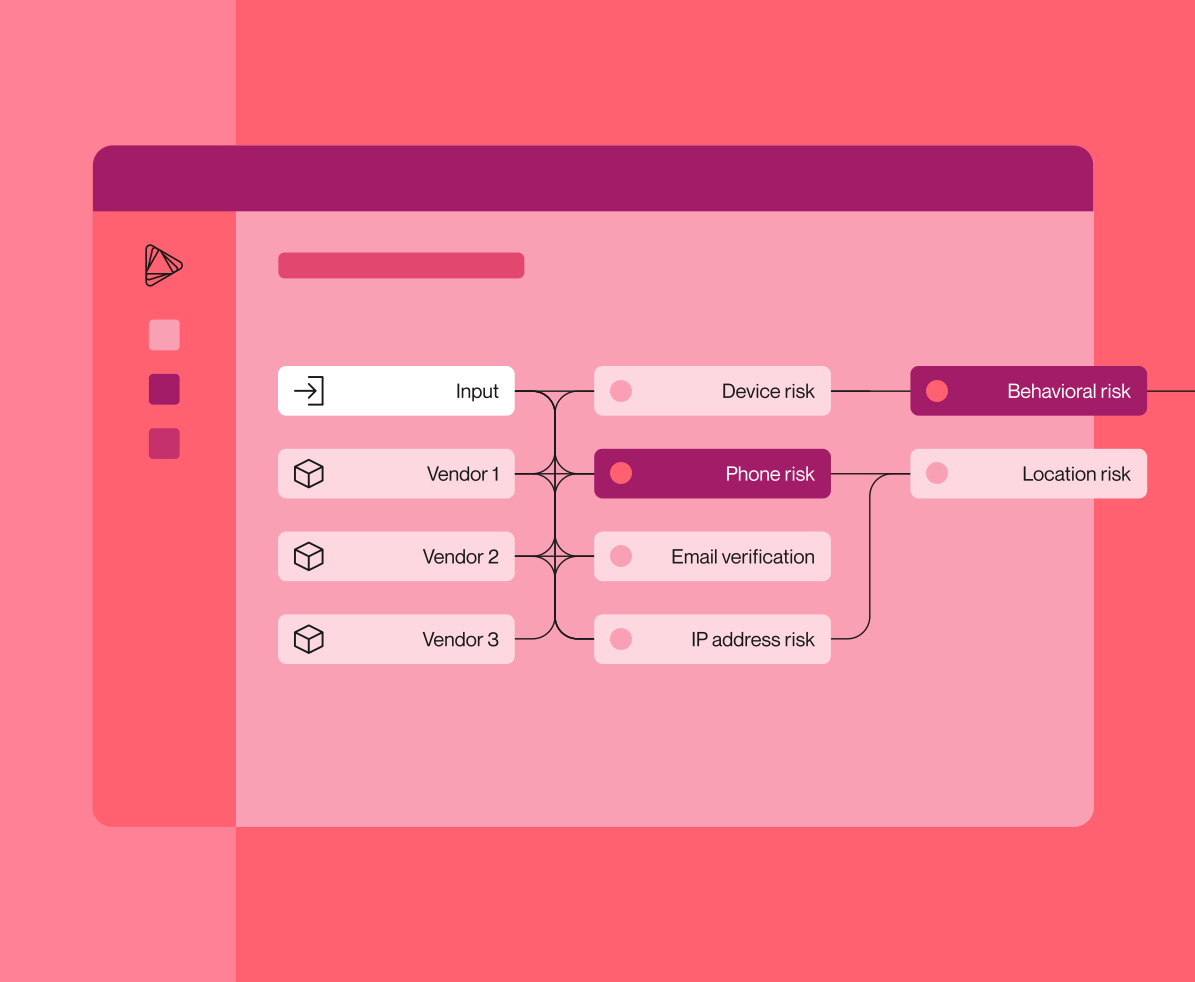
The shift to risk-based authentication is essential for helping financial institutions determine when additional identity verification or authentication is necessary. Alloy provides the risk-based decisioning and orchestration, while identity providers such as Prove supply the trusted data and authentication capabilities institutions can invoke within those workflows.
Much of the conversation around fraud today focuses on AI-generated attacks. While those capabilities are changing how fraudsters operate, the more immediate operational challenge for most financial institutions is prioritization.
Fraud teams are losing because they struggle to determine which signals actually deserve action and which represent acceptable levels of risk. Risk-based authentication shifts the conversation from reacting to the latest fraud trend to making consistent, evidence-driven, real-time decisions across every customer interaction.
A new layer of intelligence
One of the most valuable applications of pre-fill technology is during the onboarding process, where financial institutions have an opportunity to both improve the customer experience and establish a trusted identity baseline from the very beginning.
Prove Pre-Fill® uses authoritative identity and carrier-backed signals to populate customer information using only a minimal input, such as a phone number. Rather than requiring applicants to manually enter extensive personal information, institutions can present much of the application already completed, dramatically reducing effort and abandonment
Convenience is only part of the value. When Prove successfully returns verified PII and device information, it provides confidence that the applicant's identity and device are consistent with authoritative data. Alloy can incorporate the verified PII and device data returned by Prove Pre-Fill into the customer’s ongoing risk profile. Alloy’s decisioning engine can then use those signals, alongside other fraud and risk indicators, to establish what “normal” looks like for that customer. That baseline can then be referenced throughout the customer lifecycle whenever future activity occurs.
When Alloy’s decisioning identifies a customer as low risk, the institution can provide a faster path from application to funded account, with less manual review and fewer unnecessary authentication challenges.
Risk-based authentication beyond onboarding
The real value of establishing a trusted baseline becomes apparent after the account is opened. After account opening, Alloy can evaluate events such as logins, password resets, profile updates, high-value transactions, and payments against the identity and device information established during onboarding.
Most of the time, it does. If Alloy determines that the customer’s activity remains consistent with the established baseline and the overall risk is low, the institution may allow the interaction to continue without an additional authentication challenge. Customers can move through digital banking actions seamlessly without repeatedly proving who they are.
When something changes, however, the institution can respond intelligently rather than treating every interaction the same. For example, Alloy may determine that a login attempt is coming from a device that doesn't match the trusted device established during onboarding with Prove Pre-Fill. Or perhaps a password reset, credential change, or high-risk transaction introduces additional uncertainty. Rather than automatically blocking the action, or forcing every customer through step-up authentication, Alloy can dynamically trigger additional verification only when it's warranted.
Alloy can incorporate authoritative, possession-based identity signals from Prove into its decisioning to help financial institutions distinguish legitimate customers from interactions that require additional scrutiny. The result is an Alloy-orchestrated, risk-based authentication strategy that applies additional verification or authentication only when the institution’s policies and risk assessment warrant it.
How Prove and Alloy work together
Together, Prove and Alloy enable financial institutions to orchestrate identity across the entire customer lifecycle. As customers continue to interact with the institution, Alloy leverages this established baseline to continuously evaluate risk for every event.
During account opening, Prove Pre-Fill helps eliminate unnecessary friction by pre-populating applications, verifying customer information, and establishing a trusted identity baseline. Alloy orchestrates these trusted signals, using them as core input for its broader decisioning engine alongside other fraud and risk indicators.
Prove and Alloy allow financial institutions to:
- Reduce friction during onboarding through intelligent pre-fill and identity verification.
- Establish a trusted baseline for every customer from the very first interaction.
- Continuously evaluate customer activity against that trusted baseline.
- Introduce step-up authentication only when changing risk conditions warrant additional verification.
- Continuously refine customer risk profiles as new trusted interactions occur over time.
Rather than forcing institutions to choose between security and customer experience, the combination of Prove and Alloy allows them to deliver both: seamless experiences for trusted customers and stronger protections whenever risk increases.
Delivering tangible value to financial institutions
For banks, credit unions, and fintechs, the benefits of this combined approach are practical and measurable.
Scalable growth without increasing risk
Across hundreds of fraud assessments and identity evaluations, a consistent pattern emerges: most financial institutions have invested heavily in individual controls, but far fewer have optimized how those controls work together. The largest gaps are often less about missing technology than incomplete orchestration, when high-confidence signals aren't consistently incorporated into decisioning or when every customer is treated as though they present the same level of risk.
As institutions expand digital acquisition, they often face a tradeoff between growth and fraud exposure. Risk-based authentication, augmented by signals like pre-fill, helps break that tradeoff. Low-risk users can onboard and use digital banking features freely, while higher-risk cases receive additional scrutiny.
Improved customer experience
Reducing friction at onboarding and throughout the customer lifecycle has a direct impact on conversion and satisfaction. Pre-fill minimizes manual data entry, shortens application times, and creates a smoother first impression without sacrificing control.
More efficient fraud mitigation
By focusing resources on higher-risk interactions, fraud teams can operate more efficiently. Instead of applying the same level of scrutiny across the board, they can use intelligent decisioning to dynamically introduce step-up authentication when necessary and prioritize cases that truly warrant manual investigation.
Flexibility and future-proofing
Through Alloy’s orchestration layer, institutions are not locked into a single approach. They can quickly test, iterate, and evolve their identity strategies as new threats emerge and new technologies become available.
Solving modern identity needs
Partnerships in the identity space are often framed in terms of coverage. More data, more vendors, more checks. But the more important dimension is coordination.
What Prove and Alloy bring together is not just additional signals, but a way to use them more intelligently. By combining Prove’s approach to pre-fill-driven risk signals with Alloy’s orchestration capabilities, financial institutions gain a more flexible toolkit for managing identity across the entire customer lifecycle.
The result is not a rigid workflow, but a dynamic system, one that can scale with growth, adapt to evolving threats, and meet the expectations of modern customers.
For decision-makers navigating the complexities of identity verification today, that flexibility is increasingly the differentiator.
Learn more about how Alloy and Prove work together

Scott Greenhut is the SVP of Partnerships and Channel at Prove, where he brings over 12 years of fintech startup hustle built on a foundational career at American Express and Chase. When he’s not scaling business development teams, he’s usually talking about all things NY sports on a podcast he co-hosts with his childhood best friend, or hitting the hiking trails with his Portuguese Water Dog, Toby.