Authentication failures are fraud prevention failures
When authentication and fraud prevention operate in silos, account takeover attacks slip through. Here's what unified detection actually looks like.
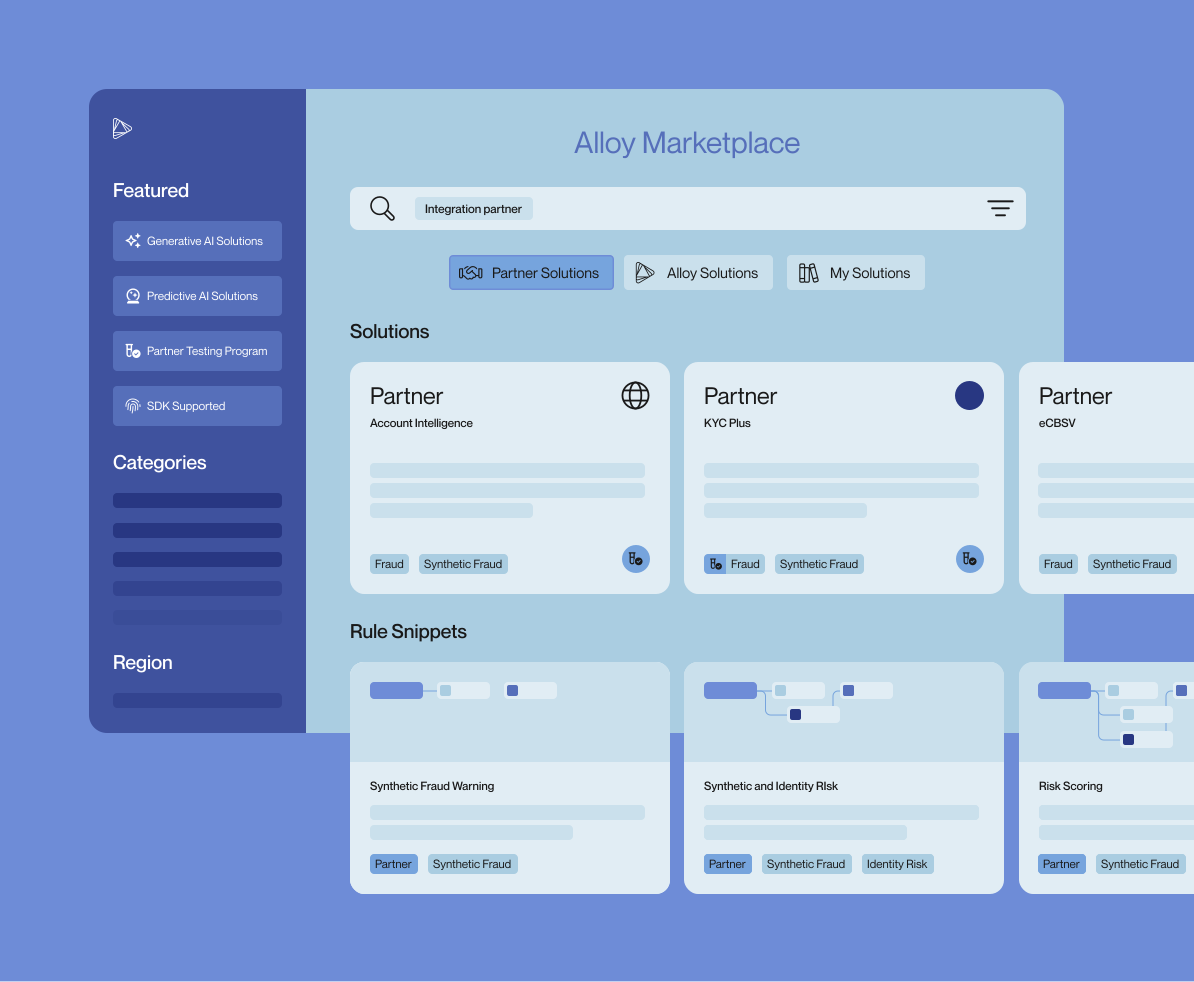
Alloy Marketplace unites 270+ partner solutions and a new library of pre-built decisioning logic in one dashboard. Discover, test, and deploy from one place.
Why spend time on tedious manual reviews when AI can do it for you? Learn how agentic AI for KYC and compliance is helping financial orgs optimize efficiency.
7th largest credit union in the U.S. drives growth by keeping members safe
Alloy’s real-time risk assessments helps IncredibleBank create a holistic risk profile for each applicant.
Alloy helps Earnest optimize customer onboarding and underwriting to boost conversion rates
Know Your Agent (KYA) is how financial institutions verify AI agents acting for customers. Learn the core controls and how it differs from KYC.
Learn how actionable AI empowers financial institutions and fintechs to move from detecting fraud to agile prevention.
Banks and fintechs run into challenges that cause customer friction when it comes to AML, KYB, and KYC regulations.
Access global digital identity verification with Alloy's eID solution for financial institutions and fintechs. Speed up growth and simplify compliance.
The 2025 CIP exemption changes how financial institutions handle KYC and TIN collection. Explore the risks, benefits, and how to stay compliant.
London, 18 June 2025 -- IG Group (“IG”), the FTSE 250 online trading company, has partnered with Alloy, a leading identity and fraud prevention platform provider. The partnership enables IG to better achieve full regulatory compliance without impinging on the company’s capacity to provide a seamless customer experience and hit ambitious business growth objectives. The UK financial services industry has developed one of the most rigorous and demanding regulatory regimes globally. Meeting compliance standards is critical to the success of any UK financial services or fintech company. Asked to name the most concerning consequences of fraud in Alloy’s recently published State of UK Fraud Report, almost all C-suite leaders at UK fintechs put satisfying regulatory requirements and mitigating reputational damage at the top of the list.* On top of this pressure to remain compliant, UK fintechs and banks also face pressure to grow. Many businesses operate on outdated, internally-built tech stacks that are too rigid to adapt to evolving demands. At the point of onboarding or verifying customers, the collection and verification of documentation is often managed manually, resulting in fragmented workflows, poor data visibility and a high volume of referrals to KYC analysts for further manual inspection. These delays and hurdles typically result in lower than desired STPs (straight through processing rates), which in turn lead to higher lead times to account activation and higher dropout rates in prospective clients. Alloy’s industry research indicates that this complexity is heightened in businesses like IG that serve customers in multiple markets globally and are processing multimillion pound transactions. Without automated workflows that enable perpetual KYC, unnecessary friction and delays can be passed onto customers. William Mead, Head of Operations at IG Group, comments: “Integrating Alloy’s identity and fraud prevention platform into our risk management processes is transforming perpetual KYC from a conceptual ideal to a real-life, proven way of operating that increases automation and efficiency, and reduces risk and development burden. “From the outset, Alloy’s UK team fundamentally appreciated the drain on capacity and resources that continual ID verification creates without the right technology in place. Alloy’s automated verification and monitoring tools help us refocus our attention and efforts to deliver the sort of user experience an IG customer expects from us. By continually ensuring we know who our customers are in accordance with expanding regulatory rules, the experience we can provide feels less intrusive, less onerous and more streamlined.” By leveraging Alloy, IG has been able to develop a dynamic and holistic approach to risk management through the client lifecycle from onboarding to in-life. This approach reduces the potential for regulatory risk, alleviates the need for remediation efforts after risks are exposed, and improves customer conversion and retention. At the same time, Alloy enables IG to consolidate operational workflows in all jurisdictions and orchestrate multiple data signals for due diligence flows based on risk level and geographic requirements, which results in far more automated processes and fewer manual activities. Since integration, IG has experienced a significant increase in automated activations. Most of the time previously spent handling remediation efforts after risks were retrospectively exposed is deployed elsewhere on activities like proactively improving internal processes and enhancing the customer journey.James Baston-Pitt, Alloy’s Head of Growth UK, EMEA and APAC, adds: “IG is an exceptional company that has been focused and collaborative in making bold transformations to their customer decision-making and in-life processes. Balancing the importance of robust, compliant, and seamless experiences globally involves fine-tuning customer journeys to maximise automation in both core and expansion markets. We are very excited about what we have achieved together so far.”Notes to Editors * 93% of UK fintech C-Suite leaders rank regulatory penalties and reputational damage as the most concerning consequences of fraud - Alloy State of UK Fraud Report, March 2025About IG GroupIG Group (LSEG:IGG) provides online trading platforms and educational resources to empower ambitious clients around the globe. Headquartered in the UK, IG Group is a FTSE 250 company that offers clients access to ~19,000 financial markets worldwide. www.iggroup.com About AlloyAlloy provides an identity and fraud prevention platform that enables global financial institutions and fintechs to manage identity risk so they can grow with confidence. Over 700 of the world’s largest financial institutions and fintechs turn to Alloy’s end-to-end platform to access actionable intelligence and the broadest network of data sources across the industry, as well as stay ahead of fraud, credit, and compliance risks. Founded in 2015, Alloy is powering the delivery of great financial products to more customers around the world. https://www.alloy.com/uk
An identity and fraud prevention platform is an end-to-end platform for managing fraud, credit, and compliance risk, providing the clearest picture of customers throughout the entire customer lifecycle.
London, United Kingdom, March 5, 2025 -- Flagstone, the UK’s largest savings platform*, has partnered with Alloy, a leading identity and fraud prevention platform provider, to deliver a seamless, automated onboarding experience for individual and business customers. The partnership allows Flagstone to approve new applications within seconds, without impinging on the highest standards of security and compliance, and integrate global data partners into a single dashboard.By leveraging Alloy, Flagstone’s enhanced KYC (Know Your Customer) controls ensure that every new client benefits from a streamlined and intuitive onboarding journey without compromising on rigorous verification processes.With £1.1 trillion lost to financial crime annually in the UK**, financial institutions must strike a delicate balance between security and speed. Traditional onboarding processes can be manual, slow and full of friction, discouraging customers from completing applications and leaving firms vulnerable to fraud. The situation is exacerbated by a surge in AI-driven impersonations, deep fakes and organised crime rings. Together these present greater challenges for companies whose duty it is to protect themselves and their customers from the risk of financial loss. Through its partnership with Alloy, Flagstone has automated its onboarding process, reducing friction, improving conversion and pleasing customers, all without compromising security. With Alloy, Flagstone has significantly upgraded from a legacy onboarding process that sometimes took several hours and required manual oversight. Now, Flagstone has vastly increased its average STP (straight through processing rates). As a result, the company can now offer savers access to the UK market’s widest choice of savings products faster than ever before.Francesco Fulcoli, Chief Compliance and Risk Officer at Flagstone, comments: “Alloy fully understands our ambition to take a data-led approach to analysing our users’ needs and translate that back into the sort of compliant and superior customer experience we want to provide. By digitising our AML/KYC processes with Alloy, we’ve sped up exponentially how quickly savers can begin to enjoy access to hundreds of savings accounts on a single platform. Speed with certainty delights customers, serves our bank partners well, and sets us up for continued market leadership for years to come. Alloy’s automated monitoring and decisioning tools ensure we can meet our regulatory obligations efficiently while offering our customers a fast and secure onboarding experience.”James Baston-Pitt, Alloy’s Head of Growth UK, EMEA and APAC, adds: “Businesses like Flagstone must maintain a constant balance between acting in the best possible interests of their stakeholders while also maintaining a brilliant customer experience. By partnering with Alloy, Flagstone is creating a secure and stable environment in which the business can swiftly verify customer identities without causing unnecessary friction or delays - something that is paramount to the successful operation of this fast-growing, in-demand business. We’re delighted to be the engine behind Flagstone’s latest innovation.”Founded in 2013, Flagstone has grown quickly in the last three years to become the UK’s largest savings platform as more savers than ever turn to cash as a way to maximise the interest earning potential on their money in a low-risk, high-return way. Today Flagstone handles around £16 billion in assets on behalf of its individual, business and charity customers. Flagstone customers generated cumulative returns of more than £500 million on their savings in 2024 through the platform. Flagstone is also the engine behind the savings proposition for over 1000 financial services providers with whom Flagstone has API integrations or partnerships.Founded in 2015, Alloy enables global fintech companies to balance risk with growth as they serve more customers around the world. Some of the world’s fastest-growing fintechs rely on Alloy’s identity and fraud prevention platform to test, launch, and scale new products while maintaining confidence in their customers and the trust of partner banks and regulators. From supporting single-use cases like customer onboarding to powering end-to-end identity risk management, Alloy’s configurable solutions for fraud and compliance risk, dedicated expert guidance, and extensive ecosystem of data partners enable fintechs to future-proof their growth.This announcement follows the recent news that Flagstone has recorded record growth, including a 46% increase in revenue to £55 million and a 49% rise in Assets under Administration (AuA) in the twelve months to 31 December 2024.* Based on number of banks on panel and savings accounts on platform** UK Finance Annual Fraud Report 2024About FlagstoneFlagstone is a fintech company located in London that’s recreating how people grow their money. Since 2015, Flagstone’s group assets under administration stand at around £16 billion and it has become the UK’s largest savings platform by the number of banks and savings accounts on its panel. Flagstone customers can gain access to over 220 savings accounts from 66 of the UK’s leading cash savings providers, from the largest incumbent banks to challengers. Flagstone’s total AUA is currently increasing by more than £1 billion per quarter as more customers look to maximise the interest earning potential while minimising risk. Originally created as a platform for individual savers to access and maintain multiple cash savings accounts in one single place, today Flagstone provides white-label and API-integrated capabilities for businesses to offer their own customers easy-to-use, adaptable and competitive savings options. Flagstone partners with many of the UK’s leading wealth management firms including St. James’s Place, and powers a range of savings products at financial services providers including Saga and Revolut.Flagstone Group Ltd is authorised by the Financial Conduct Authority (reference number 605504) under the Payment Service Regulations 2017 for the provision of payment services. www.flagstoneim.com About AlloyAlloy provides an identity and fraud prevention platform that enables global financial institutions and fintechs to manage identity risk so they can grow with confidence. Over 600 of the world’s largest financial institutions and fintechs turn to Alloy’s end-to-end platform to access actionable intelligence and the broadest network of data sources across the industry, as well as stay ahead of fraud, credit, and compliance risks. Founded in 2015, Alloy is powering the delivery of great financial products to more customers around the world.https://www.alloy.com/uk
What did sponsor banks have to say about embedded finance compliance in 2024? Get the fast facts as stats.
Alloy’s Principal Advisor of Fraud & Identity Risk, Sara Seguin, weighs in on what today’s sponsor banks are saying about risk and compliance.
We interviewed Leslie O’Callaghan, Global Head of Legal at Adyen, about managing risk at a high-growth organization.
NEW YORK, August 21, 2024 -- Alloy, the identity risk management company trusted by over 600 leading banks, credit unions and fintech companies, today released its 2024 State of Embedded Finance Report, a survey of over 50 decision-makers working at U.S.-based sponsor banks. The report found that while embedded finance programs drive significant revenue (over 50%) for sponsor banks, a majority (80%) of respondents reported that meeting embedded finance compliance requirements as a sponsor bank is challenging in the current environment. Alloy’s State of Embedded Finance Report comes at a time when sponsor banks in the U.S. face drastically increased regulatory scrutiny. According to data from Klaros Group, 25.6% of the FDIC’s formal enforcement actions have been directed at sponsor banks since the beginning of 2024. “Running a sponsor bank program is inherently complex because you have banks who are highly regulated working with companies that are often new, fast-growing, and creating entirely new ways for consumers to interact with money,” said Tommy Nicholas, CEO and co-founder of Alloy. “Despite the challenge, we’re already seeing sponsor banks respond to regulatory developments by investing in better controls, training, and adding to their compliance tech stack.”These recent compliance violations have resulted in financial consequences for sponsor banks: Alloy’s report found that 75% of sponsor banks have lost $100k or more due to compliance violations, with 39% reporting losses of $250K or more and 6% reporting losses of $1M or more. However, financial losses are far from the worst consequence of regulatory violations: decision-makers at sponsor banks rank reputational damage as the top consequence of mishandling fintech partners’ compliance. Alloy’s report found that sponsor banks’ top barriers to maintaining a compliant embedded finance program are 1) a lack of control over their fintech partners’ policy controls and 2) a lack of auditability of their fintech partners’ policy controls. Earlier this year, Alloy launched Alloy for Embedded Finance, a product that gives sponsor banks, electronic money institutions, and program managers in the U.S., U.K., and E.U. the ability to oversee the compliance policies of their fintech partners. Alloy for Embedded Finance directly addresses embedded finance providers’ need to have greater control and visibility into their fintech partners’ compliance programs. Today, Alloy also announced a new module within Alloy for Embedded Finance: Audit Access. Tools like Alloy for Embedded Finance are becoming more widely adopted by sponsor banks: Alloy’s report found that sponsor banks’ most likely course of action in response to regulatory scrutiny is investing in new compliance technology. “Using Alloy for Embedded Finance has been a game changer for our team,” said Teddy Gordon, Director of Data at Grasshopper Bank. “We can easily set KYC requirements for our fintech partners and then roll those policies out to our entire program all at once. We ensure we’re compliant across the board, and our fintech partners still get to manage their own risk tolerance.”Alloy’s State of Embedded Finance report was fielded from May 30th to June 5th, 2024 and includes respondents from sponsor banks in the U.S. with at least $2 billion assets under management (AUM). The report was conducted on behalf of Alloy by The Harris Poll, a global consulting and market research firm.For more insights, read the full report here. About AlloyAlloy solves the identity risk problem for companies that offer financial products. Over 600 banks, credit unions, and fintechs turn to Alloy’s end-to-end identity risk management platform to take control of fraud, credit, and compliance risks, and grow with confidence. Founded in 2015, Alloy is powering the delivery of great financial products to more customers around the world. Learn more at alloy.com.
Alloy for Embedded Finance launches complimentary audit-only features for sponsor banks to view their fintech partners’ risk controls.
A guide for banks, credit unions, and electronic money institutions. By Alloy and Treasury Prime.
Alloy's Chief Product Officer reflects on the recent uptick in consent orders and shares how sponsor banks can respond.
This guide will take you through the things you should consider to create a digital strategy you can bank on.
Embedded finance solutions can help banks maintain compliance control while giving fintechs the flexibility to customize their risk management approach.
Alexis (Lex) Alexander, Chief Legal & Compliance Officer at Liberis, sits down to chat about managing compliance risk at Liberis.
Learn how recent CFPB rules and EU crypto legislation could impact your compliance programs in the short- and long-term future. Read Alloy’s mid-year check in on compliance trends.
Banks and fintechs need faster loan origination processes, but different types of credit risk complicate underwriting workflows and create more complexity. An Identity Risk Solution can help.
We chat with Rachel Sapers, Carta's Vice President and Chief Compliance Officer for AML, on how they came to work in risk management, their role at Carta, and their views on the role of risk management in driving business growth.
What started as a simple piece of technology has evolved to help banks and fintechs stay ahead of ever-changing fraud risks.
You may not know your KYB from your KBA just yet, but don’t worry; we have your back. Here’s Alloy’s cheat sheet to common terms you’ll hear when focusing on AML compliance.
Paintbrush founder & CEO Stephen Walter talks about founding a fintech, finding a sponsor bank, and staying compliant as regulatory attention on bank/fintech partnerships intensifies.
We take a look at the evolution of fraud technology over the past two decades to help gain a better understanding of how banks and fintechs can fight fraud, maintain their customers’ trust, and continue to keep up with customer expectations for the onboarding experience—even as new threats emerge.
In honor of the official/unofficial holiday in celebration of marijuana — lovingly referred to as "4/20" — we take a look at cannabis compliance requirements. Experts from BCB Community Bank and Shield Compliance share their tips for banks and fintechs thinking about opening a cannabis program.
There’s been a lot of talk about how customers only want to operate online nowadays. In response, businesses are focused on building or improving their digital experience — and they should be. Gen Z and millennials tend to opt for online experiences before in-person ones, but that doesn’t mean you can forget about your in-person experience.