Authentication failures are fraud prevention failures
When authentication and fraud prevention operate in silos, account takeover attacks slip through. Here's what unified detection actually looks like.
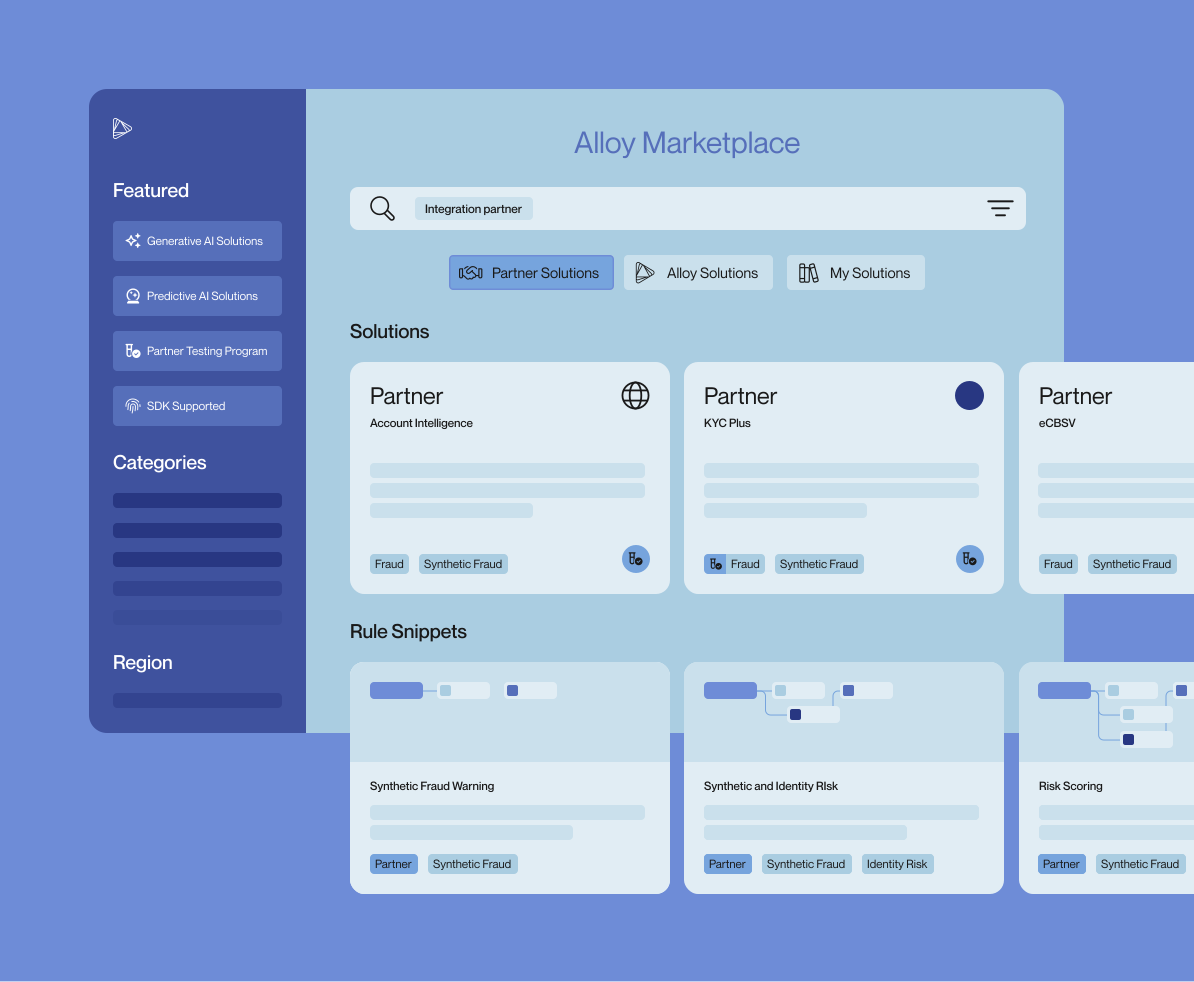
Alloy Marketplace unites 270+ partner solutions and a new library of pre-built decisioning logic in one dashboard. Discover, test, and deploy from one place.
Why spend time on tedious manual reviews when AI can do it for you? Learn how agentic AI for KYC and compliance is helping financial orgs optimize efficiency.
7th largest credit union in the U.S. drives growth by keeping members safe
Alloy’s real-time risk assessments helps IncredibleBank create a holistic risk profile for each applicant.
Alloy helps Earnest optimize customer onboarding and underwriting to boost conversion rates
Know Your Agent (KYA) is how financial institutions verify AI agents acting for customers. Learn the core controls and how it differs from KYC.
Learn how actionable AI empowers financial institutions and fintechs to move from detecting fraud to agile prevention.
Banks and fintechs run into challenges that cause customer friction when it comes to AML, KYB, and KYC regulations.
What started as a simple piece of technology has evolved to help banks and fintechs stay ahead of ever-changing fraud risks.
You don’t want to get caught in a fraud attack and then have to scramble to figure out how to respond, build new workflows and integrate with new data providers. We share some tips on how you can stay one step ahead of fraudsters.
Our Employee Experience Manager, Ted Lord, breaks down what makes Alloy's culture unique.
You may not know your KYB from your KBA just yet, but don’t worry; we have your back. Here’s Alloy’s cheat sheet to common terms you’ll hear when focusing on AML compliance.
Keep bad customers out and let the good ones in while bolstering an identity-focused fraud prevention model. What you need is a thorough, automated step-up verification process. Learn more.
Lending decisions have relied heavily on credit scores since they were first introduced in the late-1950s. However, some FIs have recently started incorporating alternative sources of data into their lending decisions. After more than 60 years of trusting credit scores, what is prompting our industry to rethink them?
Many financial institutions are still using a “Day-2” fraud review process. We explain why Day-2 reviews should be a last resort and how FIs can catch fraud in real-time instead.
One of the leaders of Alloy's LGBTQ+ employee resource group (ERG), Ariana Longoria, reflects on her experience as a lesbian employee at Alloy and shares how Alloy celebrates Pride yearlong.
Many banks and fintechs are turning to AI as their choice tool to combat the widespread rise in fraud. Meanwhile, fraudsters are leveraging AI to outsmart banks and fintechs. We take a look at the new double-edged sword in fraud-fighting.
What is first-party fraud? Let’s look at some examples, identify key challenges, and find out how to fight back with automated fraud processes, KYC, and ongoing monitoring.
Learn more about recent fraud trends and how these predictions can help you make a better business case for proactive fraud prevention and the anti-fraud tools you need.
May marked Asian American & Pacific Islander (AAPI) Heritage Month. AAPI @ Alloy did not disappoint by planning some special programming to help the Alloy community celebrate.
Paintbrush founder & CEO Stephen Walter talks about founding a fintech, finding a sponsor bank, and staying compliant as regulatory attention on bank/fintech partnerships intensifies.
Many members of the underbanked population have no or thin credit files — which, in a classic case of what comes first, the chicken or the egg — makes it even harder for them to acquire a credit card. But how can organizations safely verify and underwrite these populations? I asked experts from Alloy, Equifax, Nova Credit, Zest AI, and Ocrolus to find out.
We take a look at the evolution of fraud technology over the past two decades to help gain a better understanding of how banks and fintechs can fight fraud, maintain their customers’ trust, and continue to keep up with customer expectations for the onboarding experience—even as new threats emerge.
Another month, another set of excellent events from Alloy’s Employee Resource Groups (ERGs)! Trail Blazers (our ERG for women @ Alloy) hosted a panel with Women in Fintech and a volunteer event. HOLA (our Hispanic Organization & Leadership ERG) hosted a spicy salsa social. Meanwhile, the DEI Committee is hard at work behind the scenes planning company-wide training programs for the rest of the year.
In honor of the official/unofficial holiday in celebration of marijuana — lovingly referred to as "4/20" — we take a look at cannabis compliance requirements. Experts from BCB Community Bank and Shield Compliance share their tips for banks and fintechs thinking about opening a cannabis program.
Do faster payments mean faster fraud? We break down real-time payments and what they mean for your fraud controls.
Tax season brings with it new potential for fraud against Americans, and the numbers reveal that they are both aware of this threat and concerned about it. In this blog, we dig into the data around consumer fraud fears and discuss the repercussions for financial institutions.
There’s been a lot of talk about how customers only want to operate online nowadays. In response, businesses are focused on building or improving their digital experience — and they should be. Gen Z and millennials tend to opt for online experiences before in-person ones, but that doesn’t mean you can forget about your in-person experience.
There's no way to sugarcoat it. Banks and fintech companies alike are getting crushed right now by small business account fraud. In this blog, we break down what types of small business banking fraud to look out for and how to prevent it.
What is a Suspicious Activity Report (SAR)? Who is required to file a SAR? When do you need to file one? How do you file one? — Alloy's Director of Compliance answers all these questions and more.
Our employee resource groups (ERGs) hosted some amazing events over the past month, and our employees celebrated Black History Month and Women’s History Month.
KYC, KYB, and AML laws require financial institutions to verify a company’s (and its beneficial owners’) identity before offering the business financial services or products. We break down the nuances of onboarding sole props vs. LLCs.